

Why Electronics Manufacturers in Malaysia Need Video Measuring Systems
Malaysia has established itself as a key hub for electronics manufacturing, supporting industries such as semiconductors, consumer electronics, and precision components. As the demand for smaller, more complex, and highly accurate electronic parts continues to grow, manufacturers face increasing pressure to maintain strict quality standards. This is where a video measuring system Malaysia solution becomes essential.
A video measuring system (VMS), also known as a video measuring machine (VMM), uses advanced optics and imaging technology to perform precise, non-contact measurements. For electronics manufacturers, this technology is not just beneficial—it is critical for maintaining consistency, accuracy, and efficiency in production.
The Growing Challenges in Electronics Manufacturing
Electronics manufacturing involves extremely fine components such as printed circuit boards (PCBs), microchips, connectors, and miniature assemblies. These parts often feature intricate geometries and tight tolerances that are difficult to measure using traditional tools like calipers or micrometers.
Common challenges include:
- Measuring tiny and delicate components without causing damage
- Maintaining consistent quality across high-volume production
- Detecting defects that are invisible to the naked eye
- Meeting strict international quality and compliance standards
Without the right measurement tools, these challenges can lead to production errors, increased waste, and costly rework.
What is a Video Measuring System?
A video measuring system Malaysia manufacturers rely on is a precision instrument that uses high-resolution cameras, lenses, and software to measure the dimensions of components accurately. Unlike contact-based tools, VMS performs measurements without physically touching the object, making it ideal for fragile electronic parts.
Key capabilities include:
- 2D and 3D measurement
- Edge detection and automatic measurement
- High magnification for micro-level inspection
- Data recording and reporting for quality control
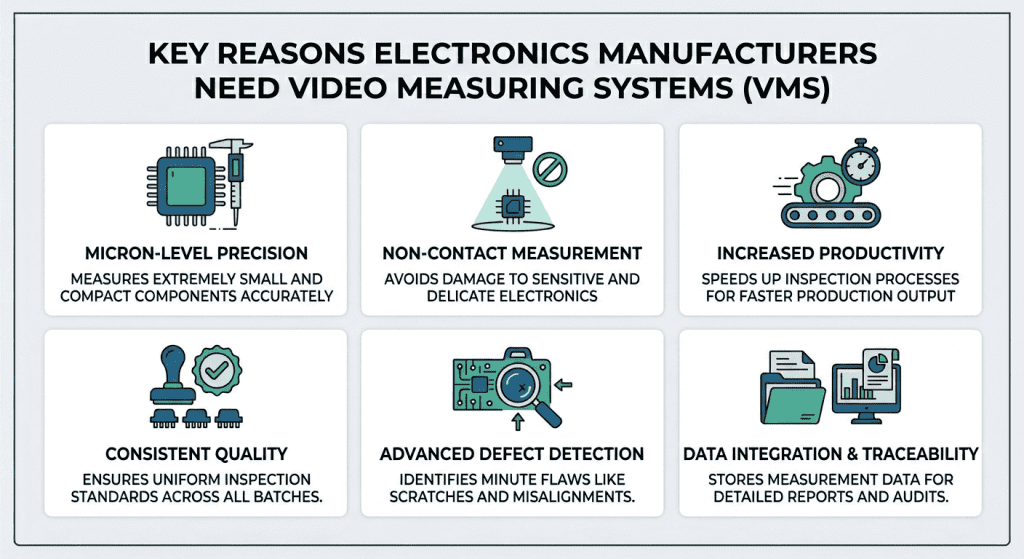
Key Reasons Electronics Manufacturers Need Video Measuring Systems
1. High Precision for Micro Components
Electronics components are becoming increasingly compact, requiring measurement accuracy at the micron level. Video measuring systems provide extremely high precision, ensuring every component meets design specifications.
2. Non-Contact Measurement for Delicate Parts
Many electronic components are sensitive and can be easily damaged by physical contact. A video measuring system eliminates this risk by using optical measurement, preserving product integrity.
3. Faster Inspection and Increased Productivity
Manual inspection methods are time-consuming and prone to human error. Automated video measuring systems significantly speed up the inspection process, allowing manufacturers to maintain high production output without compromising quality.
4. Improved Quality Control and Consistency
Consistency is crucial in electronics manufacturing. Video measuring systems ensure uniform inspection standards across batches, reducing variations and defects.
5. Advanced Imaging for Defect Detection
With high-resolution cameras and advanced software, VMS can detect even the smallest defects, such as misalignments, scratches, or dimensional inaccuracies, that may otherwise go unnoticed.
6. Data Integration and Traceability
Modern video measuring systems can store measurement data and generate detailed reports. This helps manufacturers maintain traceability, meet audit requirements, and continuously improve their processes.
Comparison Table: Traditional vs Video Measuring Systems
| Feature | Traditional Measuring Tools | Video Measuring System |
|---|---|---|
| Measurement Method | Contact | Non-contact |
| Accuracy Level | Moderate | High (micron-level) |
| Risk of Damage | High for delicate parts | None |
| Speed | Manual & slower | Fast & automated |
| Repeatability | Operator-dependent | Highly consistent |
| Data Recording | Limited | Automated & digital |
Applications in Malaysia’s Electronics Industry
A video measuring system Malaysia solution is widely used across various electronics applications, including:
- PCB inspection and measurement
- Semiconductor component verification
- Connector and micro-part inspection
- Quality control for precision assemblies
These systems are especially valuable in high-tech manufacturing environments where accuracy and repeatability are critical.
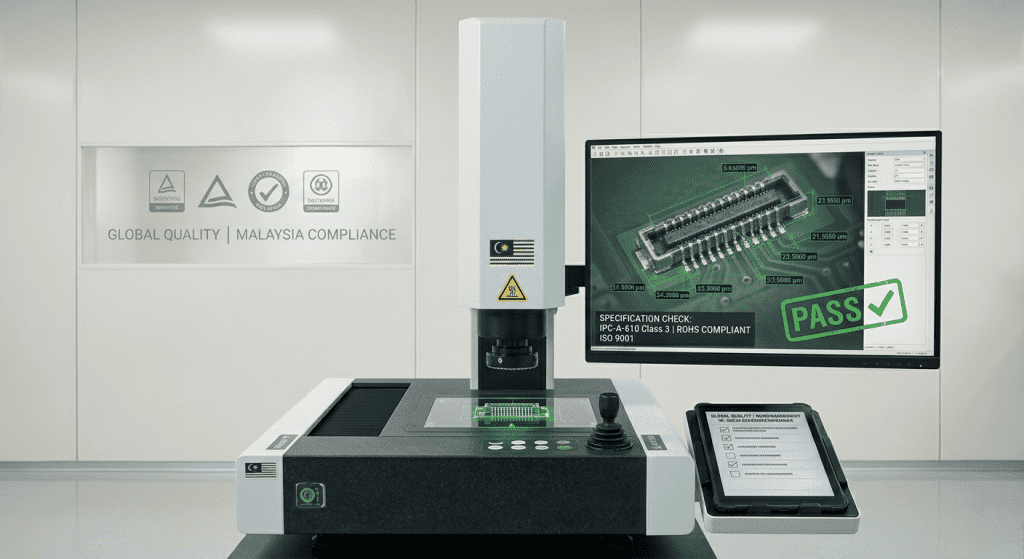
Supporting Industry Standards and Compliance
Electronics manufacturers in Malaysia often need to comply with international standards and certifications. Video measuring systems help ensure that all components meet required tolerances and quality benchmarks, supporting compliance with industry standards and customer expectations.
The Future of Measurement in Electronics Manufacturing
As Industry 4.0 continues to evolve, the integration of automation, artificial intelligence, and smart manufacturing is transforming the way measurements are performed. Video measuring systems are becoming smarter, faster, and more connected, enabling real-time quality control and predictive analysis.
For Malaysian electronics manufacturers, investing in advanced measurement technology is no longer optional—it is a strategic move to remain competitive in the global market.
Conclusion
In today’s fast-paced and precision-driven electronics industry, maintaining quality and efficiency is more challenging than ever. A video measuring system Malaysia solution provides the accuracy, speed, and reliability needed to meet these demands.
By adopting video measuring systems, electronics manufacturers can reduce errors, improve productivity, and ensure consistent product quality—ultimately strengthening their position in Malaysia’s thriving manufacturing sector.
Frequently Asked Questions (FAQs)
What is a video measuring system used for in electronics manufacturing?
It is used to measure and inspect small and complex electronic components with high precision using non-contact optical technology.
Why is non-contact measurement important for electronics?
Non-contact measurement prevents damage to delicate components and ensures accurate results without physical interference.
How accurate are video measuring systems?
They can achieve micron-level accuracy, making them suitable for high-precision industries like electronics and semiconductors.
Can video measuring systems improve production efficiency?
Yes, they automate the inspection process, reducing manual work and speeding up quality control.
Are video measuring systems suitable for high-volume manufacturing?
Yes, they are designed to handle fast and repetitive inspections, making them ideal for large-scale production environments.