

Common Quality Control Problems Solved by Video Measuring Systems
Maintaining consistent quality control is one of the biggest challenges in modern manufacturing. Even small measurement errors can lead to rejected products, production delays, material waste, and increased operational costs.
To improve inspection accuracy and production consistency, many manufacturers are investing in a Video Measuring System in Malaysia as part of their quality control process. Combined with proper VMM Training in Malaysia, factories can improve measurement reliability, reduce human error, and achieve better long-term manufacturing performance.
What Is a Video Measuring System?
A Video Measuring System (VMM) is a non-contact optical inspection system that uses high-resolution cameras, precision lenses, and software to measure parts accurately.
Instead of relying on manual measurement tools, the system captures digital images and analyses dimensions automatically. This provides faster and more consistent inspection results, especially for small or delicate components.
Common Quality Control Problems in Manufacturing
Many factories experience recurring quality control issues that affect product consistency and production efficiency.
Human Measurement Errors
Manual measurement depends heavily on operator skill and experience. Different operators may produce different inspection results, leading to inconsistencies in quality control.
Inconsistent Product Quality
Without standardised inspection processes, product dimensions can vary between production batches.
Slow Inspection Processes
Traditional measurement methods can slow down production, especially in high-volume manufacturing environments.
Damage to Delicate Components
Contact-based inspection tools may damage sensitive or fragile parts during measurement.
Poor Traceability and Documentation
Manual inspection records are harder to manage and may not provide proper traceability for audits or quality monitoring.
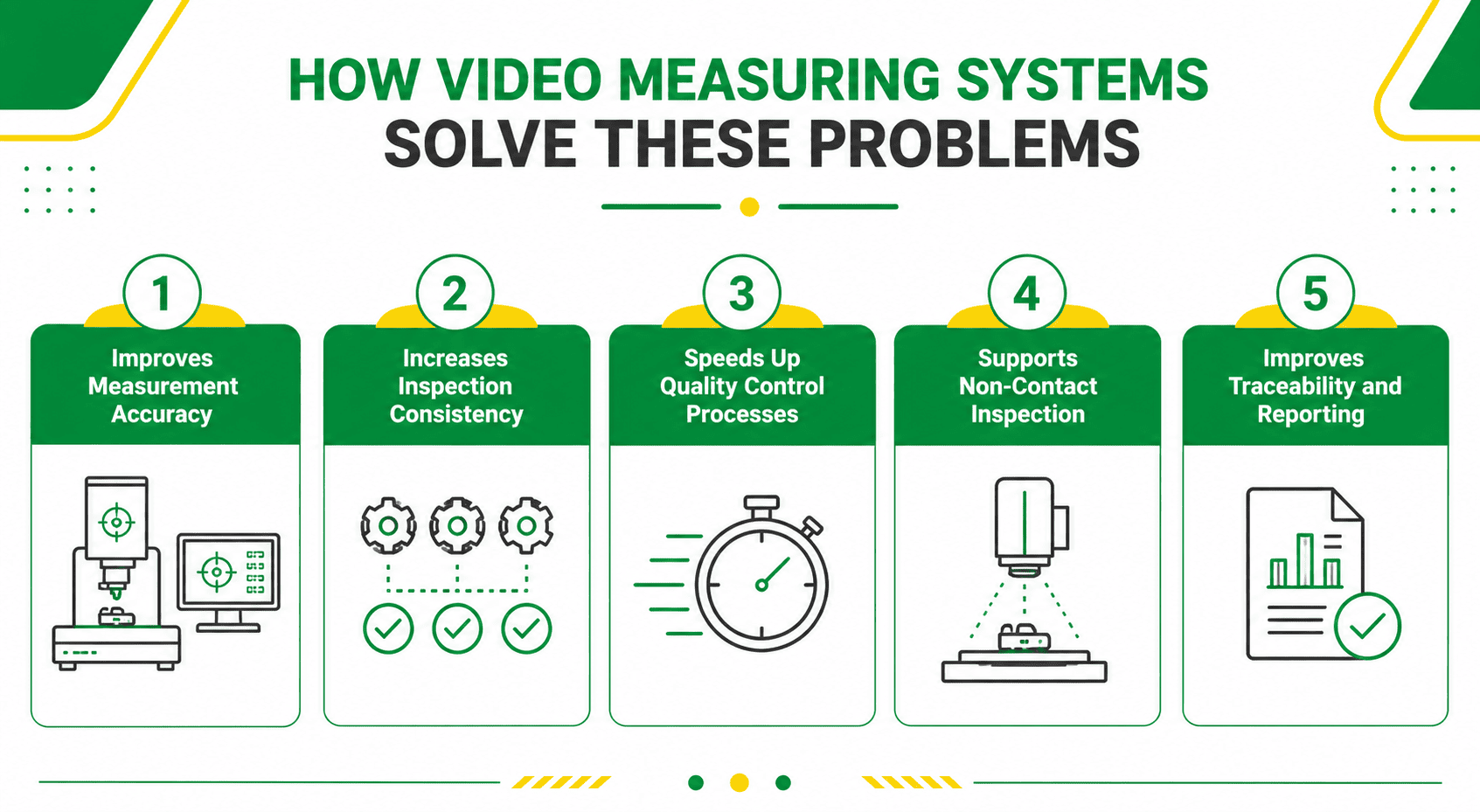
How Video Measuring Systems Solve These Problems
Improves Measurement Accuracy
Using a Video Measuring System in Malaysia helps manufacturers improve inspection precision through automated digital measurement instead of manual tools.
This allows factories to maintain tighter tolerances and reduce inspection inconsistencies.
Increases Inspection Consistency
VMM systems follow programmed measurement routines, ensuring every part is inspected using the same process and standards.
This improves consistency across:
- Different operators
- Production batches
- Repetitive inspection cycles
Speeds Up Quality Control Processes
Automated image processing allows inspections to be completed much faster compared to manual measurement methods.
This helps manufacturers:
- Improve production efficiency
- Reduce inspection bottlenecks
- Increase workflow productivity
Supports Non-Contact Inspection
One major advantage of using a Video Measuring System in Malaysia is non-contact measurement.
This is especially useful for:
- Electronics components
- Medical devices
- Plastic products
- Precision-engineered parts
Sensitive components can be inspected accurately without risk of physical damage.
Improves Traceability and Reporting
Modern VMM systems automatically store digital inspection data for easier tracking and reporting.
This helps manufacturers:
- Maintain inspection records
- Improve audit preparation
- Monitor recurring quality issues
- Enhance production traceability
Industries in Malaysia That Benefit from Video Measuring Systems
Video measuring systems are widely used across Malaysian industries that require precise and reliable inspection.
Electronics and Semiconductor Manufacturing
Used for inspecting miniature and highly sensitive components with tight tolerances.
Automotive Manufacturing
Supports precision measurement for automotive parts and assemblies.
Medical Device Production
Ensures dimensional accuracy and consistent product quality.
Precision Engineering Industries
Helps manufacturers maintain strict inspection standards and reduce defects.
Importance of VMM Training in Malaysia
Even advanced inspection systems require skilled operators for maximum performance. Proper VMM Training in Malaysia ensures operators understand correct measurement procedures, software functions, and inspection workflows.
Training helps manufacturers:
- Reduce operational mistakes
- Improve measurement consistency
- Increase inspection efficiency
- Maximise system performance and reliability
Well-trained operators play an important role in maintaining accurate and stable quality control processes.
Why More Manufacturers Are Investing in Video Measuring Systems
As manufacturing standards continue to increase, companies are moving toward more automated and data-driven inspection systems.
Using a Video Measuring System in Malaysia helps factories:
- Reduce dependency on manual inspection
- Improve production quality
- Increase operational efficiency
- Support long-term manufacturing growth
This makes video measuring technology an increasingly valuable investment for modern factories in Malaysia.
Enhance Inspection Accuracy for Your Manufacturing Process
Achieve more consistent quality control and reduce production errors with advanced video measuring technology built for modern industrial applications. We provide reliable solutions and technical support to help manufacturers improve inspection performance and operational efficiency.
Speak with our team today to find the right VMM system for your factory
Conclusion
Many common manufacturing quality control problems, including human error, inconsistent inspection results, slow measurement processes, and poor traceability, can be improved by using a Video Measuring System in Malaysia.
With better inspection accuracy and more consistent quality control processes, manufacturers can improve production efficiency, reduce defects, and maintain higher manufacturing standards for long-term operational performance.
Frequently Asked Questions (FAQs)
What is a video measuring system used for in manufacturing?
A video measuring system is used to inspect and measure parts accurately without physical contact, helping manufacturers maintain consistent product quality.
Which industries commonly use video measuring systems in Malaysia?
Industries such as electronics, semiconductor, automotive, medical devices, and precision engineering commonly use video measuring systems for quality control.
How does a video measuring system improve quality control?
It improves quality control by increasing measurement accuracy, reducing human error, speeding up inspection processes, and providing more consistent inspection results.
Can video measuring systems inspect delicate components?
Yes. Since the system uses non-contact measurement, it is suitable for delicate or sensitive components that may be damaged by traditional inspection tools.
Why is VMM training important for operators?
Proper VMM training helps operators use the system correctly, reduce measurement errors, improve inspection efficiency, and maintain consistent quality standards.